
My Freedamn! by Rin Tanaka: The Book That Took T-Shirts Seriously
Posted by Admin IOS on
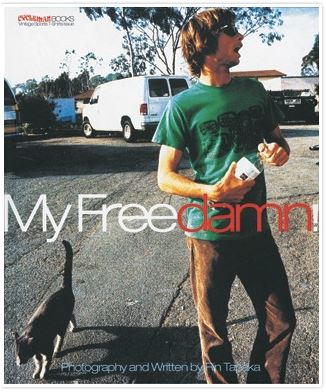
Somewhere around 2003 a Japanese collector named Rin Tanaka published a book about American t-shirts, and the vintage trade in three countries quietly reorganised itself around it.
What the book is
My Freedamn! is a series, self-published, with each volume built around one corner of American vintage: motorcycle jackets, surf, workwear. The 2003 volume is the t-shirt one. Hundreds of shirts from surf shops, skate companies, motorcycle dealers and hot rod garages, photographed flat and clean, with the people who wore them alongside.
It was not written by an American. That turns out to matter. Tanaka photographed the shirts the way a collector photographs anything he takes seriously: as objects with makers, dates and provenance. Americans mostly hadn’t done that with t-shirts because the shirts were furniture. He looked at them from far enough away to see them.
Why it matters to us
The transfer wall is the part of that story that never got its own book.
Before the screen-printed shirts in Tanaka’s pages became the norm, a t-shirt shop in America was a wall of iron-on sheets and a heat press. You picked the image, picked the shirt, and five minutes later you were wearing it. Roach Studios ran an advertisement showing exactly that:
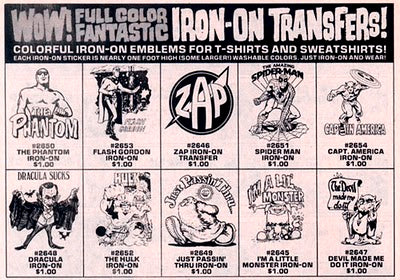
Every shirt in that ad started as a sheet like the ones in our boxes. The shirt got worn out and thrown away. The unused sheets didn’t.
So what we hold is the step before Tanaka’s book: the source material, not the finished garment. Six hundred and forty-seven catalogued sheets, a hundred and one of them from Roach with printed dates running 1966 to 1984, plus Holoubek, Vortex, Suzy’s Zoo and the anonymous majority nobody will ever attribute.
The same method, applied to paper
We’ve tried to do for transfers what that book did for shirts. Photograph each one. Write down who printed it and when, from the evidence on the sheet. Say unknown where it’s unknown rather than guess. Put it where anyone can check it.
The result is an index of every printer we can name, a reconstruction of Roach Studios from its own dated output, and a method for dating a sheet with no copyright line.
If you found this from Japan
A fair number of you do. The Japanese market for American vintage is the most serious in the world, and it’s the market Tanaka’s books came out of.
We ship there. Every sheet is original, unused, and never a reproduction; that is the whole business, and we don’t bend it. If you’re a shop, a stylist or a collector and you want to see what we hold before it goes on the site, write to us. English is fine. Short is fine.
Your own history
What was your first iron-on shirt? Where did you get it pressed? What did the shop look like?
We’re collecting those stories, and photographs of the shops and the shirts, on a page we call the Time Capsule. Nobody photographed transfer walls on purpose. What survives is accidental, and it’s in shoeboxes. Send it before it goes in the bin.
Share this post
1 comment
This post is an awesome atpmtet to cover most of casual clothing. T-shirts have always been an interest for me. I have bookmarked the page and will refer it to my friends too.